

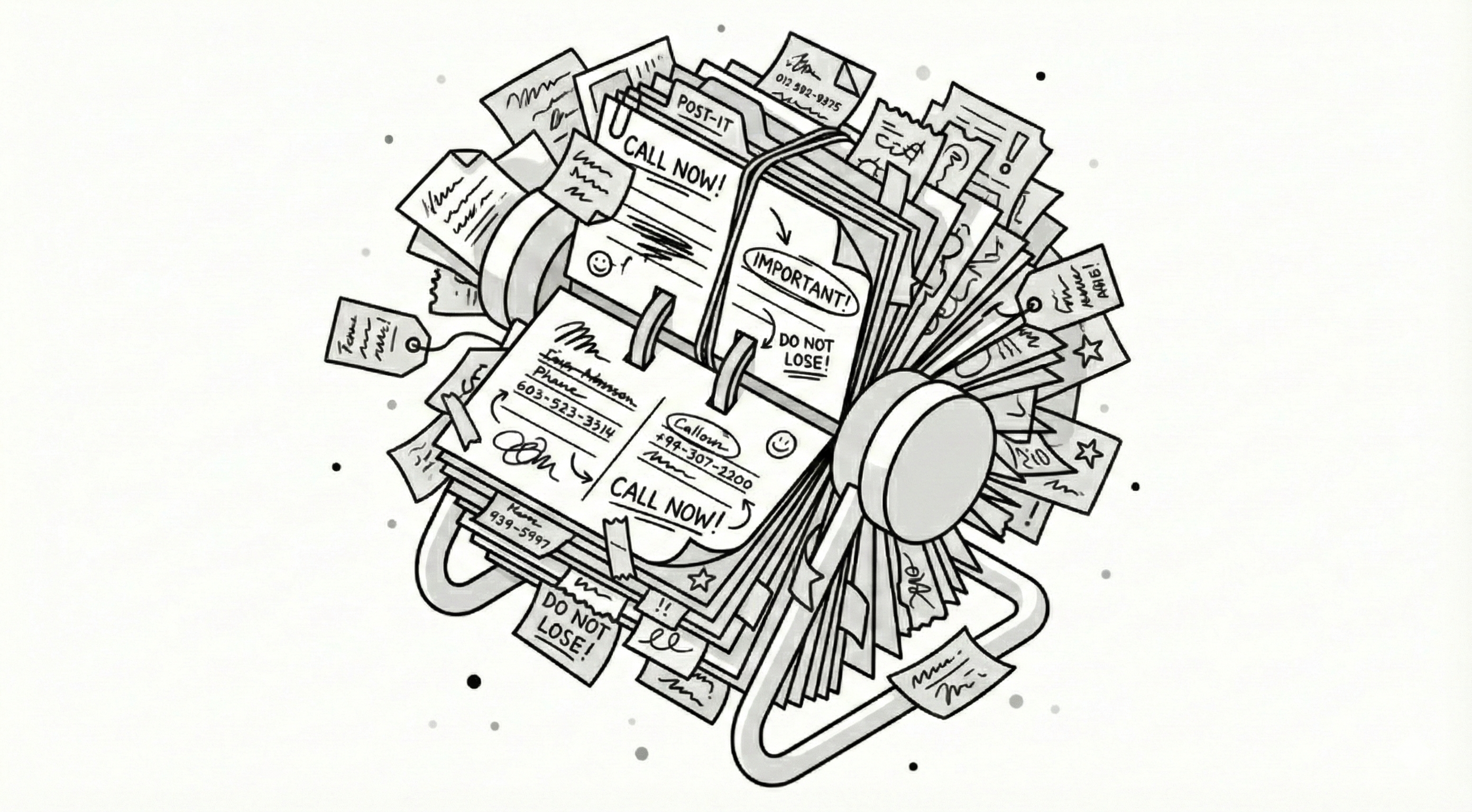
Before the Customer Relationship Management(CRM), existed the Rolodex — A simple, personal, and flexible solution that the sales person owned, not the company. Through the SaaS revolution, this personal(often priceless) item has been digitised, institutionalised and enhanced with two design principles in mind - unified structure over personal convenience, and controlled, centralised ownership over autonomy. The silently accepted norm(holding up an $80 billion industry), in the era of Agentic AI, needs a re-examination with a fresh set of principles. Principles that move us closer to the rolodex, but with smarts and a Swiss Army knife.
INFO
This focuses on a specific type of sales professional: the salesperson working on a complex B2B deal over months, not the SDM who’s setting up campaigns for thousands by the click of a button. They navigate stakeholder politics, build trust across a buying committee, and precisely time the right message. Their edge lies in judgement, relationships, and a system of record for customer relationships that includes LinkedIn DMs, Apple Notes, WhatsApp threads, and human memory above and beyond what the CRM offered.
Why Now?
Era of agency and “taste”
Now(if not, in the near future), anyone can complete a 10 step automated research to generate a detailed report, approach strategy and more. Now, this begs the question - what is your edge? your nuanced "taste" that sets you apart?
AI Agents are already capable and will only get more capable. Instead of thinking about how we can automate things we already do, the real mavericks are thinking from a blank slate -
What can we now do, which I couldn’t earlier?
This fuzzy, subjective question demands tools and infrastructures that enable and not dictates or creates boundaries.
The empowered will find a way, but lower the barriers just enough and they will map new territories.
The new barriers
Primary Cost is Headspace
Abstract away from the nitty gritty details, focus on the orchestration.
The most important cost is going to be the cost of headspace. The prompt that I used once, the workflow that just worked that one time. The Era of Experience needs to reflect in work as well. You want the thing to work, and if there’s a tweak, it needs to be easy and persistent.
Continuous, Relentless Change
Models, wrappers, agents are all going to evolve, that’s the only guarantee. When you know that should you invest time and energy in
Since everyone is building shovels for the era of AI, anything is an API call away, but as OpenClaw demonstrated, there’s merit in exploring web-first
Agents, like Humans, don’t like databases
The SaaS era has been fueled by the relative cheap cost of reading and writing into databases. Softwares has been designed keeping the constraints of databases in mind.
Designed for Agents and Humans, not Databases
These changes give us an opportunity to reimagine how our tools should work.
The Design Principles
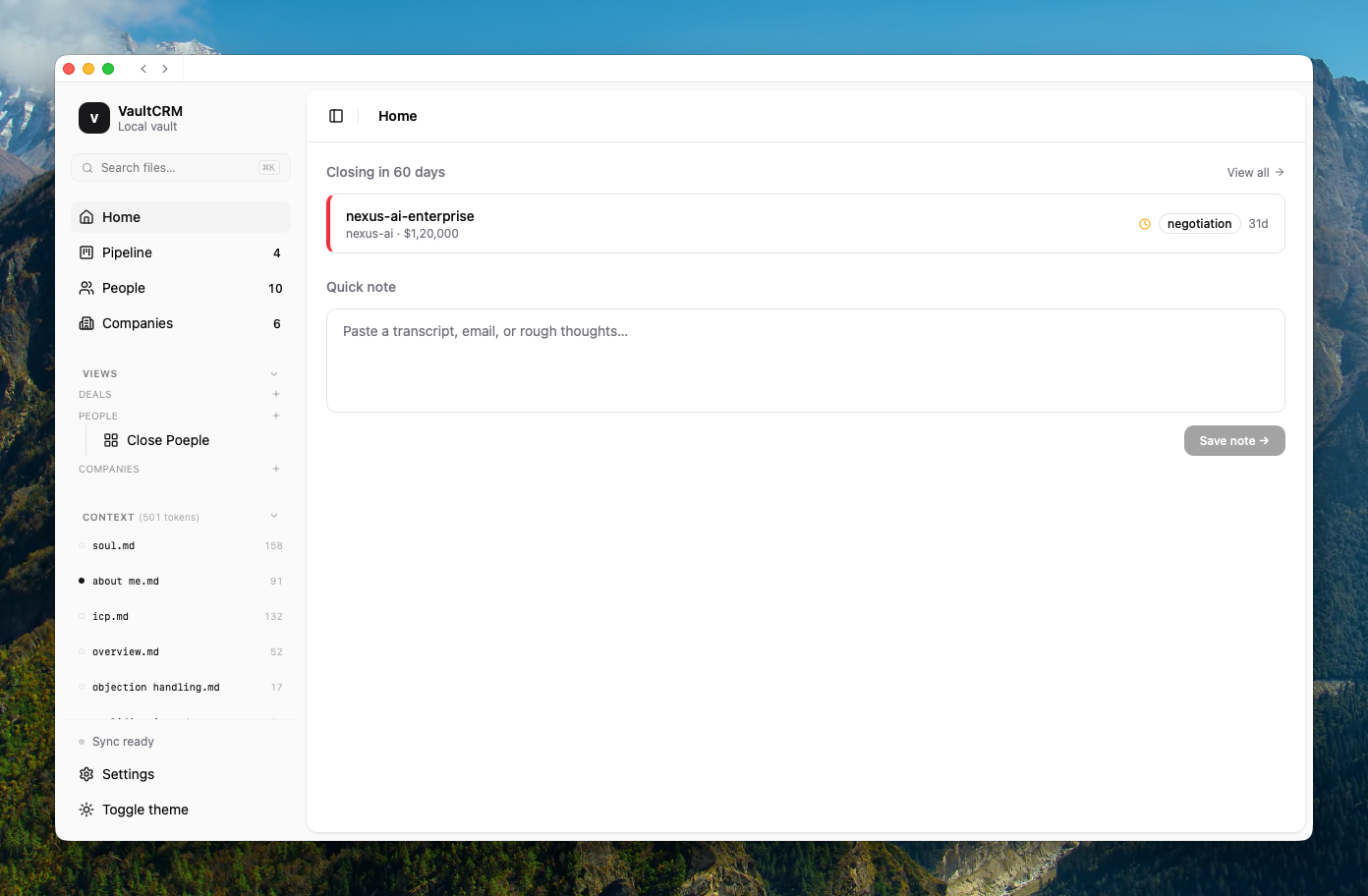
- Owned & Maintained by the individual. The person who built the relationships maintained the system, because the system was theirs. It is an asset that appreciates over time, because you’ve invested to make it work for you. Not something you restart with when you start a new job. Find a new capability you want, add it…don’t like it? remove it, just as easy.
- Agent enabled, not Agentic. This feels counterintuitive. But, the only thing guaranteed about AI agents right now is that they will get dramatically better, dramatically fast. Rather than depend on the SaaS provider to catch up, you need simple, non-technical and reliable ways to add, remove and tweak your systems, on your timelines, not on theirs.
- Files over databases. Read/write to a database was cheap, structured and predictable - this fuelled the deterministic era of software. In the Human-Agentic era, databases have become a shared barrier, while simple markdown files are the resilient, portable, infinitely flexible, and understandable architecture for both humans and agents.
What this looks like
A recent YC startup Dench seems to be going this way, but missing a couple of the main points, risking shooting itself on the foot.
- DuckDB as the database layer
- Agentic capabilities built in - wrapper around openclaw
- Terminal driven ⇒ Most sales folks don’t know how to use the terminal
 What is going to stand out is creativity and a personal touch that the human brings on board.
- Agents enable intelligent action.
- Plugins provide extensibility without technical know-how.
- When everyone is doing the same things, and your outreach involves sending a personalized message that is a LinkedIn scrape with some AI-generated perfection, the true edge will lie in the human touch, human imperfections.
The technical
A folder in your system
vault/
├── people/
│   ├── david-liu.md
│   ├── rachel-torres.md
├── companies/
│   ├── nexus-ai.md
│   ├── techflow-labs.md
├── deals/
│   ├── nexus-ai-enterprise.md
├── notes/
│   ├── 2025-01-14-nexus-discovery.md
├── playbooks/
│   ├── qualification.md
│   ├── competitive/
├── .personal/            ← never syncs
│   ├── private-notes/
│   └── relationship-patterns/
└── .vault/
    ├── config.md
    └── plugins.md
The interface The swiss army knife Sync meetings & prep for meetings
The use cases demo
- Prep for a call
- Review the call
- Enrich
- Remind
Writing
Rolodex
-
Rolodex Concept CRM fundamentally acts like a Rolodex of relationships. Stores and organizes information about contacts, companies, and interactions.
-
Agent as an External Entity The agent sits outside the CRM system. It interacts with the CRM rather than being embedded inside it.
-
Agents Talk to CRM & Take Actions Agents can communicate with the CRM. They can trigger actions or workflows within the CRM.
-
Skills as the Execution Layer Skills act as the layer that performs actions. They execute tasks requested by the agent.
Key Principle Skills and agents are separate components. 5. Open Question What happens if the company still needs to update the CRM manually? Implication: the system should handle or reconcile manual updates with agent-driven actions.
Anatomy of a plugin
- Anatomy of a plugin
- Claude Legal Plugin
- Plugins as the matrix package
- Neo learning new Lang / Karake
- Why it’s hard — the impact that it has
Cleaned-up Structured Notes
-
Anatomy of a Plugin
- Example reference: Claude Legal Plugin
- Implies examining:
- Inputs the plugin receives
- How it connects to the LLM
- APIs / tools exposed
- Output format and responses
-
Plugins as the Main Package
- Idea: Instead of a monolithic product, structure the system around plugins. Possible components:
- Interpretation:Plugins act as modular capabilities that the core system can call when needed.
-
Why This Is Hard
- Plugins introduce complexity in coordination
- Need to manage:
- Tool routing
- API reliability
- Data format consistency
- Latency and cost But the impact is large because plugins unlock:
- specialized capabilities
- extensibility
- domain-specific workflows