

I want to push beyond just the CTO or the CPO and bet on most of it merging into a single CPTO role.
Key Responsibilities of a CTO in a Nutshell
- Strategy: Deciding which technologies will solve business problems and provide a competitive edge.
Leadership: Managing developers and building a high-performing engineering culture.
Key Responsibilities of a CPO in a Nutshell
- Vision & Roadmap: Deciding the long-term future of the product and prioritising which features to build next.
- User Advocacy: Using data and research to represent the “voice of the customer” in every executive decision.
- Growth & Lifecycle: Managing products from the first idea (ideation) to launch and eventually to retirement (sunsetting).
| Feature | Chief Product Officer (CPO) | Chief Technology Officer (CTO) |
|---|---|---|
| Core Question | ”What should we build and why?" | "How can we build it reliably?” |
| Primary Focus | The Product (User Value & Market Fit) | |
| Key Output | Product Roadmap & User Experience (UX) | Tech Stack & |
How we answer the question: “What should we build and why?”
The Process Evolution until now
.png)
1. Traditional (Waterfall)
- Philosophy: Predictability & Risk Mitigation.
- Workflow: Business Case → Requirements Doc (PRD) → Handover → Build → Launch.
- Fatal Flaw: The “Big Bang” Risk. You don’t test until the end. If you were wrong 6 months ago, you have wasted 6 months of budget.
- Best For: Low-trust environments, government contracts, hardware.
2. Modern (Dual-Track Agile)
- Philosophy: Continuous Discovery & Validation.
- Workflow: Two parallel tracks running simultaneously.
- Discovery Track: Rapid experiments (prototypes, smoke tests) to validate ideas before coding.
- Delivery Track: Building production-ready code only for validated ideas.
- Advantage: Speed of Learning. You fail fast and cheap.
- Best For: Most SaaS companies, startups, high-growth tech.
3. The “Shape Up” Approach (Fixed Time, Variable Scope)
- Philosophy: Anti-Backlog & Autonomy.
- Workflow: Shaping (Rough sketches & boundaries) Betting Table (Strategic commitment) Building (6-week uninterrupted cycle) Cool-down (2 weeks).
- Advantage: Focus & Shipping. It guarantees a release every 6 weeks by aggressively cutting scope rather than moving deadlines.
- Best For: Mature product teams, Basecamp-style cultures, and teams trying to escape “Agile/Scrum hell” (endless tickets).
The AI Revolution (Reimagining Shape Up)
.png)
Combining Basecamp’s Shape Up methodology (Fixed Time, Variable Scope) with Agentic AI creates three divergent futures for product development.
Branch 1: The “Simulation-First” Approach (The Risk Killer)
- Concept: AI doesn’t just write code; it simulates the market. Instead of launching an MVP to real users to see if it fails, you launch it to a “Synthetic Audience” first.
- The Shift: Instead of betting on human intuition, you bet on Simulation Confidence Scores.
- Workflow:
- Shape: CPO defines a “Synthetic Cohort” (e.g., 1,000 AI agents configured with specific personas: “The Skeptic,” “The Power User,” “The Price-Sensitive Manager”).
- Test: Feed the product concept/prototype to the cohort. The agents “use” the product and generate logs of their frustration or delight.
- Bet: Only build if the Synthetic Cohort shows high engagement/retention metrics.
- Real-World Example: You want to test a new, aggressive pricing popup. Instead of risking annoying real users, you deploy the popup to 5,000 synthetic agents based on your historical user data. The simulation predicts a 15% increase in churn. You kill the idea before writing a single line of production code.
Branch 2: The “Ephemeral Software” Approach (The App Killer)
- Concept: The “Product” is not a static set of hard-coded screens (e.g., a “Settings Page” or a “Dashboard”). It is a set of capabilities that generates the necessary UI on the fly based on user intent.
- The Shift: Moving from “Building UIs” to “Building Latent Space.”
- Workflow:
- Shape: CPO/CTO define the Guardrails (Brand guidelines, Color palette, Data Access Policies) and the Capabilities (e.g., “The AI can read the Sales SQL database”).
- Build: Engineers don’t build screens; they fine-tune the model to understand the business domain and hook up the API tools.
- Run: The UI is generated Just-In-Time.
- Real-World Example: User A asks, “Show me sales by region.” The software instantly generates a Map Component. User B asks, “Who are the top 3 reps?” The software instantly generates a Leaderboard Component. Neither the Map nor the Leaderboard existed in the code 5 seconds ago—the AI assembled them from a design system to answer the specific query.
Branch 3: The “Hyper-Cycle” Approach (The Solo-Founder Scale)
- Concept: One human orchestrating a swarm of specialized AI Agents to act as a full product team.
- The Shift: Compressing the 6-week Shape Up cycle into a 6-hour deep work session.
- Workflow:
- Morning (Shape): Human defines the problem and sketches a rough concept on a whiteboard (uploaded to AI).
- Noon (Swarm):
- Agent A (Architect): Reads the sketch and writes the technical plan.
- Agent B (Coder): Writes the boilerplate and functional code.
- Agent C (Red Team): Actively tries to hack the code or find bugs in Agent B’s work.
- Evening (Ship): Human reviews the Pull Request, manually tests the “happy path,” and deploys to production.
Real-World Example:
A solo founder realizes users need a “Delete Account” feature. Instead of putting it on a backlog for next month, they prompt the Swarm. By lunch, the Architect has designed the database soft-delete logic, the Coder has built the UI, and the Red Team has verified that users can’t delete other people’s accounts. Feature shipped by 5 PM.
The AI Revolution (Reimagining Traditional Agile/Sprints)
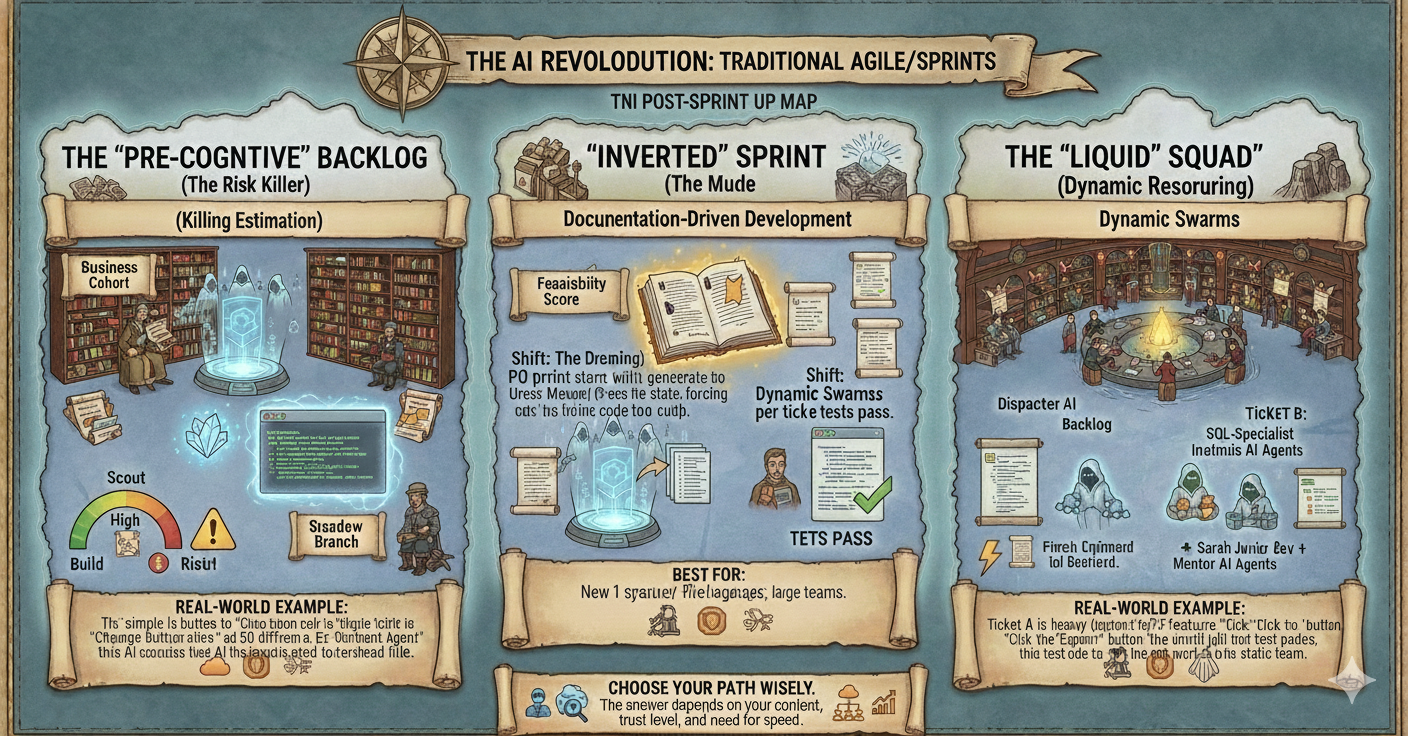
For teams committed to Scrum/Sprints rather than Shape Up, AI fundamentally fractures the standard 2-week cycle into three new branches of possibility.
Branch 1: The “Pre-Cognitive” Backlog (Killing Estimation)
- Concept: The Backlog becomes an active AI participant, not a static list of text tickets.
- The Shift: Moving from “Guessing Effort” (Pointing) to “Feasibility Scouting.”
- Workflow:
- Scout: As soon as a ticket enters the backlog, an AI Agent (“The Scout”) creates a shadow branch and attempts to solve the ticket immediately.
- Report: It doesn’t need to finish. It reports back: “I tried to implement this. I found that
UserAuth.tsis legacy code and upgrading it broke the Billing Service. This is high risk.”
- Real-World Example: The team is planning the next sprint. A “simple” ticket to “Change the button color” is flagged by the Scout Agent as a “5-pointer” because the button component is hard-coded in 50 different files. The team avoids a time-trap because the AI scouted the terrain ahead of time.
Branch 2: The “Inverted” Sprint (Documentation-Driven Development)
- Concept: Generative AI is better at “hallucinating” the perfect end-state than incremental logic. We leverage this by writing the end-state first.
- The Shift: The Sprint starts with the “Done” state (Documentation/Tests), forcing the code to catch up.
- Workflow:
- Day 1 (Dreaming): Product Owner prompts AI to generate the User Manual, the Press Release, and the Integration Tests that would pass if the feature existed.
- Day 2-10 (Realizing): Engineers and AI Agents work solely to make those tests pass. The “Docs” act as the strict prompt for the code generation.
- Real-World Example: The goal is a new “Export to PDF” feature. On Day 1, the AI writes the Help Center article: “Click the ‘Export’ button to download a PDF.” It also writes a Cypress test that clicks that non-existent button. The developers’ only job is to write code until that test passes. The documentation leads the development.
Branch 3: The “Liquid Squad” (Dynamic Resourcing)
- Concept: No fixed “Squads” (e.g., 2 Backend, 1 Frontend). A fluid pool of human talent and AI Agents.
- The Shift: Dynamic Swarms assembled per ticket, not per quarter.
- Workflow:
- Dispatcher: At Sprint start, a “Dispatcher AI” analyzes the backlog’s technical needs.
- Assembly: It assigns resources dynamically based on the specific ticket requirements.
- Real-World Example: Ticket A is a heavy database migration. The Dispatcher assigns “Dave (Human DB Expert)” + “3 SQL-Specialist AI Agents.” Ticket B is a simple CSS cleanup. The Dispatcher assigns “Sarah (Junior Dev)” + “1 Mentor AI Agent.” The team structure changes every sprint to match the work, rather than forcing the work to fit a static team.
The “Genesis” Protocol (A Clean-Slate Rethink)
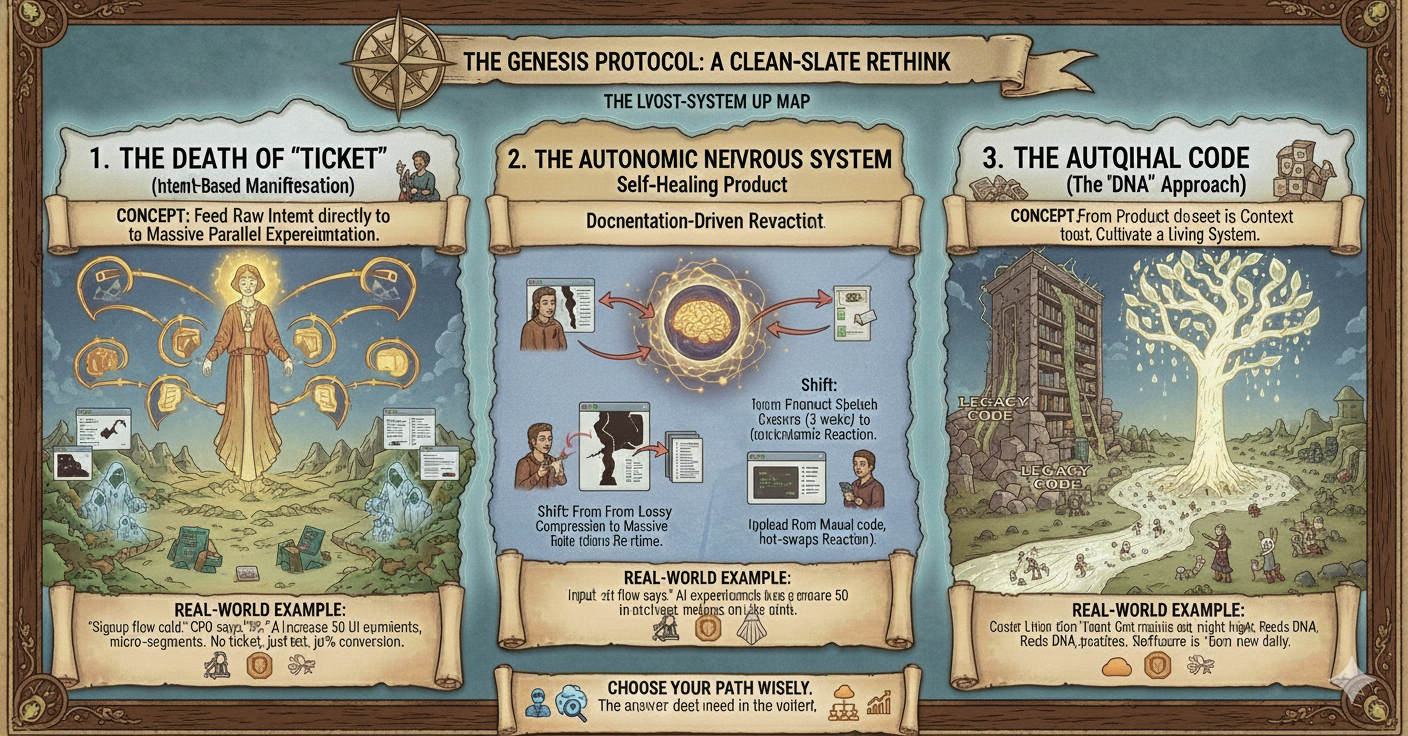
If we strip away all baggage—forgetting Agile, Scrum, and even “Product Management” as a career—and look strictly at the capabilities of 2025+, we arrive at a model that resembles Biology more than Engineering.
The Core Premise: All previous methodologies exist to manage the High Cost of Change and Human Coordination Overhead. If AI reduces the cost of change to near-zero and eliminates coordination friction, the “Cycle” (Sprint/Shape Up) becomes obsolete.
The “Living System” Paradigm
- The Shift: From Construction (Stacking bricks one by one) to Cultivation (Guiding a self-growing organism).
- The “Why”: Technological progress is moving towards Recursive Self-Improvement. Static software that waits for a human to update it is a liability.
1. The Death of the “Ticket” (Intent-Based Manifestation)
- Old World: Humans translate a goal (“Increase Signup”) into atomic tasks (“Move button 5px”). This is “Lossy Compression.”
- New World: You feed the Raw Intent directly to the System.
- Workflow:
- Input: CPO says, “The signup flow feels cold. Make it friendlier and reduce drop-off by 5%.”
- Execution: The System (a mesh of LLMs) analyzes “Friendly” via sentiment analysis of successful competitor sites, generates 50 variations of the copy/UI, and deploys them to micro-segments of traffic instantly.
- Result: The “Ticket” never existed. The Outcome is achieved through massive parallel experimentation.
2. The Autonomic Nervous System (Self-Healing Product)
- Old World: A user encounters a bug. They report it. Support tickets it. PM prioritizes it. Dev fixes it. (Time: 3 weeks).
- New World: The Product observes itself.
- Workflow:
- Observation: The System detects a rage-click or a console error in real-time.
- Reaction: The System instantly pauses that session, rewrites the crashing code block based on the error stack trace, hot-swaps the module, and resumes the user’s session.
- Memory: The System updates its own “Genetic Memory” (System Prompt) to avoid that pattern in the future.
3. Ephemeral Code (The “DNA” Approach)
- Old World: The “Asset” is the codebase. We protect it, lint it, and hoard it. Legacy code is a burden.
- New World: The “Asset” is the Context & Constraints. The Code is disposable.
- Workflow:
- Concept: We don’t maintain a 10-year-old
UserClass.js. - Action: Every night, the System refactors itself. It reads the current business rules (DNA) and rewrites the implementation (Body) to use the latest libraries, security patches, and performance patterns.
- Result: Zero Technical Debt. The software is “born new” every morning.
- Concept: We don’t maintain a 10-year-old
Why this is inevitable?
Because Intelligence is becoming a commodity. When intelligence is cheap, the competitive advantage isn’t “who can build the feature” (Construction), but “who can define the most valuable outcome” (Direction). We are moving from being Bricklayers to being Gods of the Simulation.