

Obsidian Metadata
| description | Don't let everyone’s AI opinions run the strategy — here are two tools to set the direction towards success. |
“Everyone has met AI. Few have understood it.”
At this point, everyone from your grandma to your CEO, to the developer sitting next to you, or even your auto-wala, has “used AI.”
That’s the problem.
Most of what people call “AI” is their experience with ChatGPT, Gemini, or Copilot — polished interfaces that hide the messy machinery underneath. What they’re actually using are products built on top of the intelligence layer — with memory, context management, retrieval, and guardrails — all the invisible glue that makes it feel like magic.
They’ve met the interface, not the infrastructure.
And when organizations plan their “AI roadmap,” everyone walks in with confidence but no shared understanding.
Everyone’s talking about potential.
No one’s talking about reliability.
Opinions aren’t bad — they just need to be grounded in what’s feasible, and at what level of confidence.
That’s where most decision-making falls flat.
Opinions aren’t operating models.
The Real Challenge Isn’t Building AI. It’s Deciding Where to Start.
Cash-rich companies today share a common storyline:
-
The leadership wants to be seen as innovative.
-
The board asks for an “AI strategy.”
-
The Slack channel fills up with ideas.
Within weeks, there are 20 half-baked use cases, three pilots, and no clarity on what will actually matter.
If only we’d mapped pain before building pilots, we’d have saved a year.
That’s exactly why I stopped starting with models or roadmaps — and started with a 2×2.
Introducing the Pain × AI Fit 2×2
Aside—Origins of this Framework
Leaning on my product manager—collaborator hat I’ve come to realise a few things about collaborative workshops/exercises (Inspired from AJ&Smart‘s Lightning Decision Jam):
- Visual anchoring is non-trivial, helps anchor people(especially when you need context to be carried across conversations)
- You need to create space for unrestricted articulation to make your collaborators feel heard and a participant in the whole process.
- Relatives convey far more meaning than absolutes; relatives also help break away from nuances
With this context, 10 mins before I got into a discovery call with a potential client, I drew up a simple grid on whimsical to prep for the call. As expected the call went well and I moved on.
It is only much later when I was on an open ended discovery call with Srix, that he pointed out the potential for this framework and inspired me to write this up.
The Framework
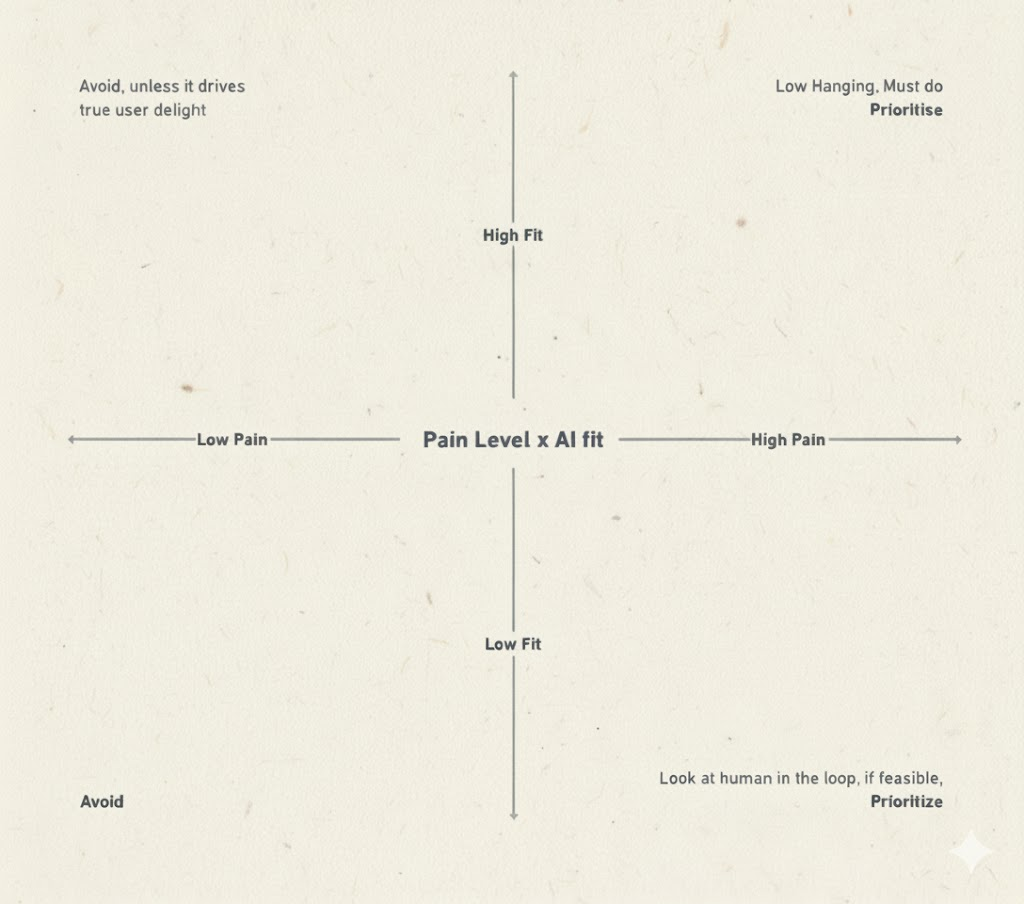 Here’s the idea:
Let the business articulate where it hurts, and let the AI team articulate what’s actually feasible. Then put both on one canvas.
| 2x2 | Low AI Fit | High AI Fit |
|---|---|---|
| Low Business Pain | Avoid — not worth it | Low-hanging, prioritise |
| High Business Pain | Look at human-in-the-loop, prioritise | Prime bets — start here |
Axes:
- X-axis → Pain Level — how big, costly, or urgent is the problem?
- Y-axis → AI Fit — how well can AI solve it versus a traditional solution?
The magic isn’t the math — it’s the conversation it forces.
When I run this live:
- Leadership fills the Pain axis with business bottlenecks.
- I score AI Fit based on data readiness, workflow stability, and reliability thresholds.
- In 90 minutes, we uncover 3–4 bets that can 10× ROI — and a parking lot of experiments that build literacy without burning budget.
Why “Pain” matters
If there’s pain, there’s already a process and a measurable outcome.
That means data, accountability, and ROI potential.
That’s where AI can earn its keep.
How to Read the Grid
🟢 High Pain × High Fit → Prioritise
This is your low-hanging gold — painful problems with clear AI solutions.
- Baker Hill, whose CEO set a 30% efficiency goal and hit it by embedding AI into workflows.
- UNIQA Insurance: chatbot cut search time by 50%, hit 95% accuracy, earned 80% NPS.
- CarMax: GPT summarised 100k+ car reviews — 11 years of work done in months. Each started with a painful, measurable bottleneck and a strong AI fit.
🟠 High Pain × Low Fit → Human in the Loop
The pain is real, but AI can’t yet replace judgment.
- JPMorgan’s COiN: 12k contracts/year, 360k hours saved, humans still approve.
AI accelerates; humans decide. That’s transformation, not substitution.
🟣 Low Pain × High Fit → Quick Wins
These are for morale and literacy, not transformation.
- Blendhub: doubled compliance output, tripled marketing content, no new headcount.
🔴 Low Pain × Low Fit → Avoid
Shiny distractions.
If it doesn’t hurt and AI can’t fix it reliably, skip it.
- Zillow: — betting on AI home pricing with little tolerance for error cost them $500M and 25% of their workforce.
If only they’d checked the quadrant first.
Beyond the Grid: The Portfolio View
Once the 2×2 gives you clarity, every idea falls into one of three buckets:
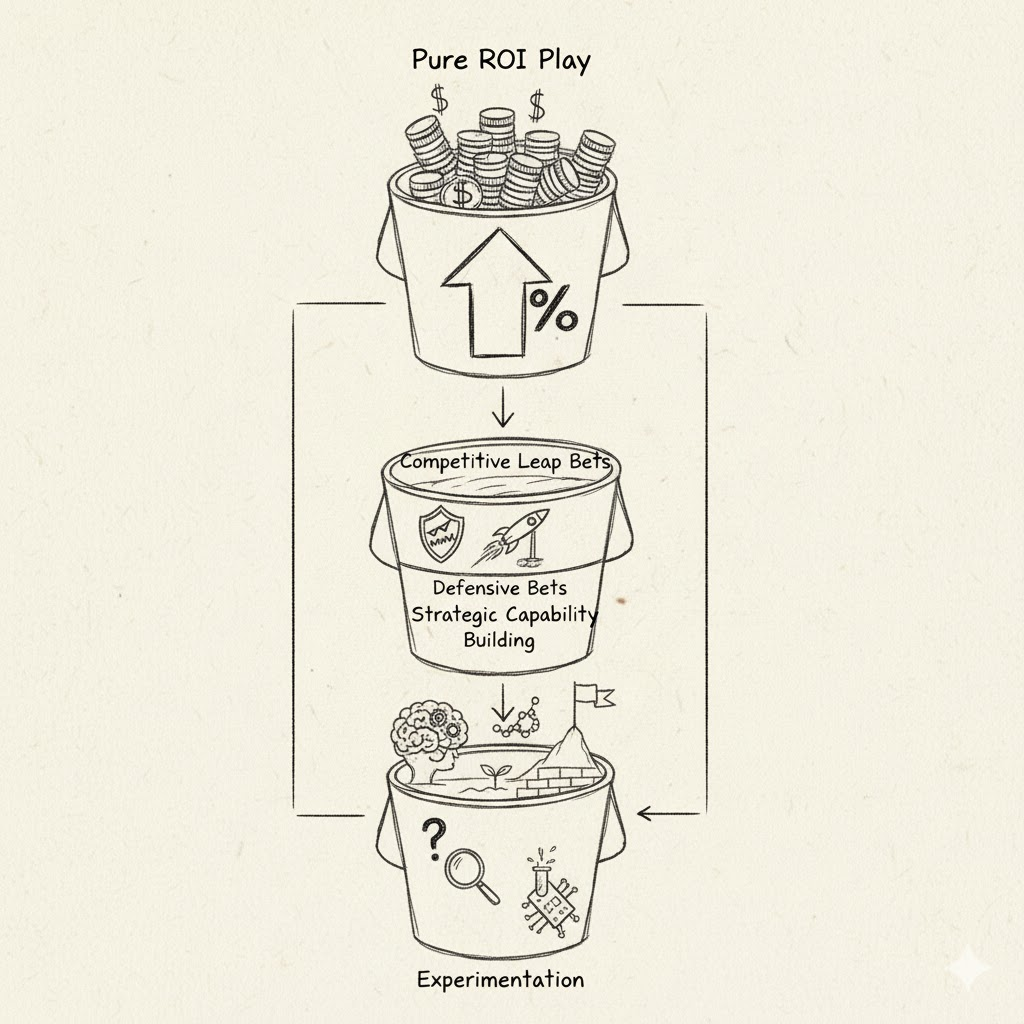
1. Pure ROI Plays
Measurable, defensible, self-funding.
High-pain + high-fit problems.
Payback in quarters, not years.
The formula: measurable pain + technical feasibility + executive ownership.
2. Competitive Leap Bets
Strategic accelerators that create non-linear advantage.
- Defensive bets (cost-cutting, resilience, operational leverage) — RT Moore’s defect-catching AI, for instance, prevented thousands in rework.
- Offensive bets (new products, markets, experiences) — like Chalo and BEST in Mumbai, where ML-based fare plans increased ridership 55% and revenue 25%. These are longer-horizon moves, but they’re what your competitors will envy a year later.
3. Everything Else = Experimentation
Everything else.
Build data, capability, and culture — but call them what they are.
Most “pilot purgatory” stories happen when experiments pretend to be transformation.
What Winning AI Organizations Do Differently
From Baker Hill to JPMorgan to Walmart, five consistent patterns emerge:
- Top-down vision + business alignment.
Every AI project maps to a clear business metric. - Governance early, not late.
Risk partners are embedded from day 1. - Cross-functional ownership.
There’s always an accountable product owner. - Metric-driven iteration.
Success = dollars saved, revenue gained, time reduced. - Pilot-to-platform mindset.
Build once, scale everywhere.
The failures (Zillow, MD Anderson) skipped all five. If only someone had owned feasibility as firmly as finance owns ROI.
Closing Thoughts — The Consultant’s Lens
When I run these sessions, I tell teams:
“Before you pick your first AI tool, pick your first AI lens.”
In two hours, we map pain versus feasibility, filter noise from signal, and leave with a prioritised AI portfolio.
No hype. Just clarity.
If your company has money, ambition, and too many AI opinions, this workshop will save you a year.
If only more companies started here, 95% of pilots wouldn’t fail.
AI isn’t failing — decision-making is.
Stop treating opinions like strategy.
Start with a whiteboard, two axes, and the courage to say,
“This hurts. That’s hard. Let’s begin there.”
You don’t need another AI demo.
You need a better way to choose your first real bet.
AI Agents Are Probably Not What You Need
Article was refined and co-worked with AI. ChatGPT - Deep Research Report - https://chatgpt.com/s/dr_690cf6db2b8881918f3ed85aea78e783