

Motivation
As the inescapable reality that AI is going to touch every business, every process, every person sets in, many teams get stuck in figuring out where and when to leverage AI. I hope this helps as a way finder.
AI Implementation Strategy: Core Buckets and Challenges
Your thinking cleanly divides AI implementation into two main strategic buckets, with everything else falling into the “experimentation” category.
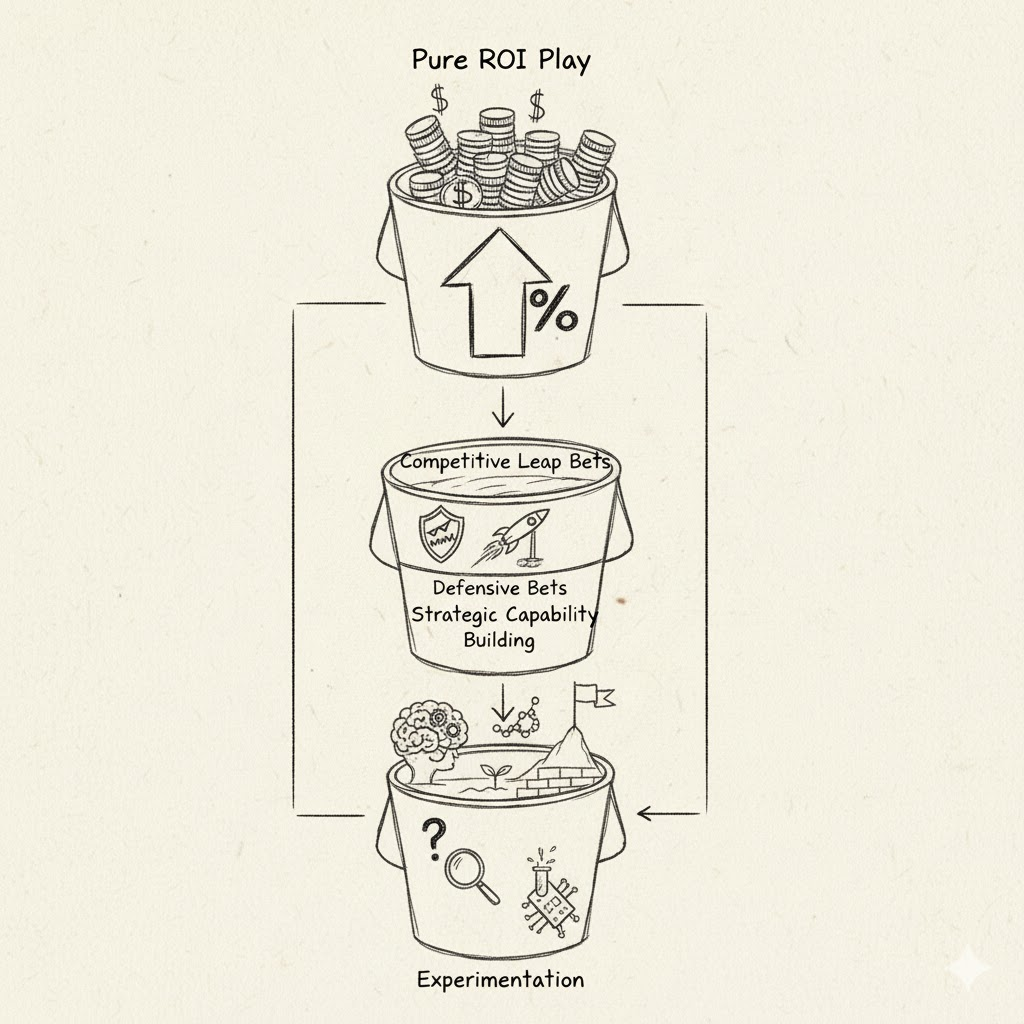
Strategic Buckets for AI Implementation
-
Pure ROI Play: Focuses on immediate, measurable Return on Investment. These are implementations where the financial payoff is clear and quantifiable, making a direct business case.
-
Competitive Leap Bets: Focuses on strategic initiatives designed to move the company three or four steps ahead of the competition. These are high-impact bets intended to create a significant, potentially non-linear, advantage. It can be useful to categorise these into:
-
Defensive Bets: Actions like radical cost-cutting or operational restructuring, aimed at protecting position and ensuring survival in the face of threats.
-
Offensive Bets: Moves such as launching disruptive products, entering new markets, or redefining customer experiences, aimed at creating future growth and leapfrogging competitors.
-
-
Everything Else = Experimentation: If an implementation doesn’t fall into the ROI or Competitive Leap buckets (i.e., it doesn’t pay for itself or create a unique advantage), it’s essentially an experiment. Experiments aren’t bad atall, but it needs to be seen, understood and treated as an such.
Now let’s look at the challenges in each of these approaches.
Pure ROI Play
The biggest obstacle in the ROI bucket stems from the ubiquity of AI and the resulting prevalence of diverse, often unqualified, opinions.
-
The “Opinion Problem”: Because many people have interacted with AI, there are now strong, widespread opinions within the business about its capabilities and limitations.
-
The Need for Concrete Alignment: The core difficulty is navigating this landscape of opinions to establish a concrete consensus on whether a specific use case, for a particular business, will genuinely deliver a measurable difference.
While consulting with organisations, the most important challenge to address is to create the space for all the opinions expressed in the point of view of pain, but still holding the baton of where is AI actually good / useful at.
The Solution: Building Frameworks: To address this, there’s a need to develop:
- Frameworks or Thought Experiments that help leadership articulate their needs/expectations.
Tools that give the business the space to express their pains, needs and wants (maybe even some aspirations) all while allowing the implementation team the space and authority to express the technical realities and guide the project toward the best possible outcome for the business.
Pain vs AI fit
Origins of this Framework
Leaning on my product manager—collaborator hat I’ve come to realise a few things about collaborative workshops/exercises (Inspired from AJ&Smart‘s Lightning Decision Jam):
- Visual anchoring is non-trivial, helps anchor people(especially when you need context to be carried across conversations)
- You need to create space for unrestricted articulation to make your collaborators feel heard and a participant in the whole process.
- Relatives convey far more meaning than absolutes; relatives also help break away from nuances
With this context, 10 mins before I got into a discovery call with a potential client, I drew up a simple grid on whimsical to prep for the call. As expected the call went well and I moved on.
It is only much later when I was on an open ended discovery call with Srix, that he pointed out the potential for this framework and inspired me to write this up.
Why "Pain"
Presence of a Pain inherently means that there is already a system in place which has some objective and outcome which is quantify-able and measurable. ROI inherently means that there is some process, problem in the system which needs addressing and is being solved in inefficient ways. These are
It functions as a discovery methodology designed to quickly determine the viability and value of an AI project by focusing on two key dimensions:
-
The Severity of the Pain (X-axis): How big, costly, and urgent is the client’s current problem or unmet need?
-
The AI Fit (Y-axis): How well-suited is an AI solution (compared to a traditional solution) to solve that specific problem, and how feasible is it to implement?
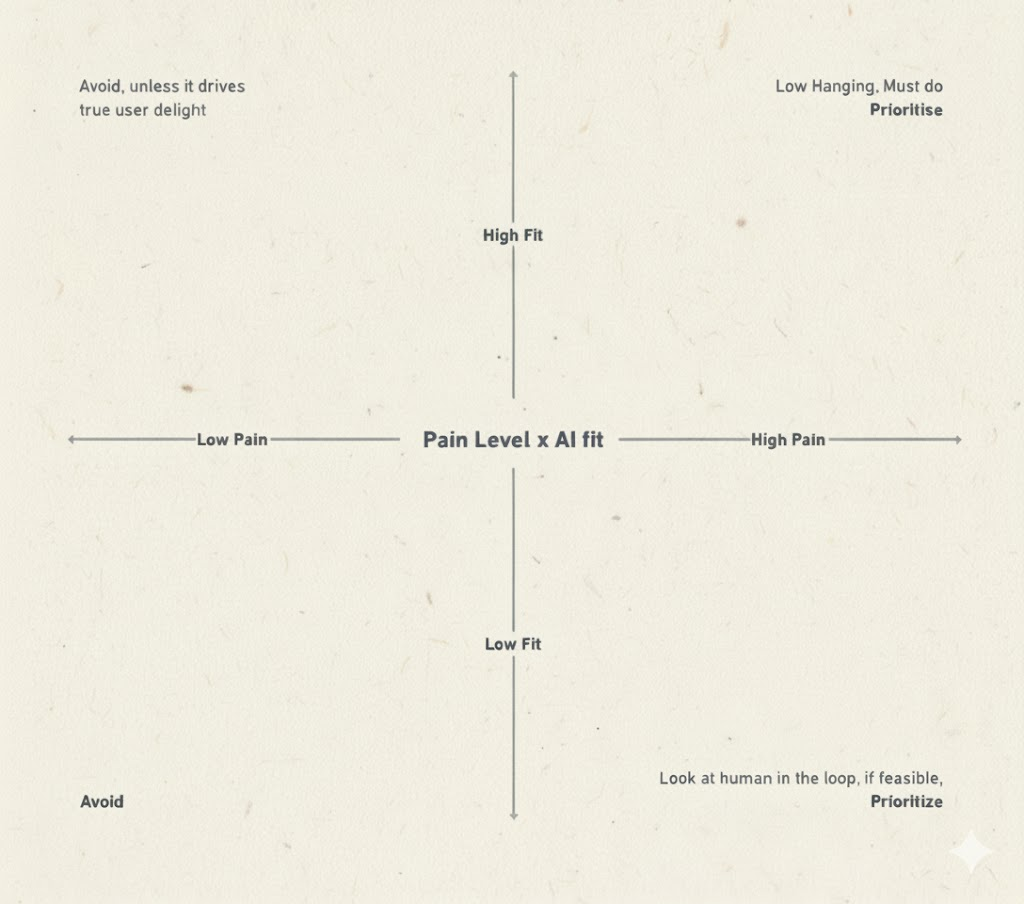
Allowing teams to place their expressions of pains
This video talks about the scale of reference for AI implementations. Stop Asking for AI Agents When You're Not Ready for Them—Here's What You Really Need